
Interview Course 2 Sections48 LessonsLifetime
Syncope – Bradyarrhythmia
You are asked to review a 78-year-old lady who has presented with a fall and fracture of the right hip. She has a medical history of hypertension, osteoarthritis and hypothyroidism. The nurse has requested a medical review as she had a brief episode of unresponsiveness after taking paracetamol orally at 7:30 pm. She is now lying comfortably in bed, with no neurological deficit and no ongoing symptoms. How would you proceed?
I would start by taking a focused history from the patient with further input from the nursing team, as required. I would ask for the events leading up to the fall: prodrome, loss of consciousness, postural change, trauma etc to understand the etiology of the fall. I would ask similar questions regarding the episode of unresponsiveness. I would then review the medical notes, blood investigations, ECG, medical imaging and drug chart to identify any obvious precipitating cause of the episode. I would follow this up with an A to E examination:
- A-Airway: I would ensure that the airway is patent.
- B-Breathing: I would assess the breathing, specifically the respiratory rate, oxygen saturations and would auscultate the chest.
- C: I would check the blood pressure, heart rate and CRT and initiate appropriate measures. I would ask for a 12 lead ECG. I would auscultate heart sounds and look for murmurs. I would also ask for bedside monitoring or telemetry. Ideally a lying and standing blood pressure should be checked in elderly patients who present with falls, but in this scenario the hip fracture would preclude this.
- D and E: I would check temperature, blood glucose and any features of acute internal or external bleeding. I would also request a venous blood gas to assess serum potassium and check/ repeat U and E.
The patient has a heart rate of 64 bpm and a blood pressure of 154/76 mm Hg. Systemic examination is largely within normal limits apart from a systolic murmur and the hip fracture. The drug chart shows that she is on Bisoprolol 1.25 mg, Doxazosin 2 mg and Omeprazole 20 mg. You review her ECG performed at admission:
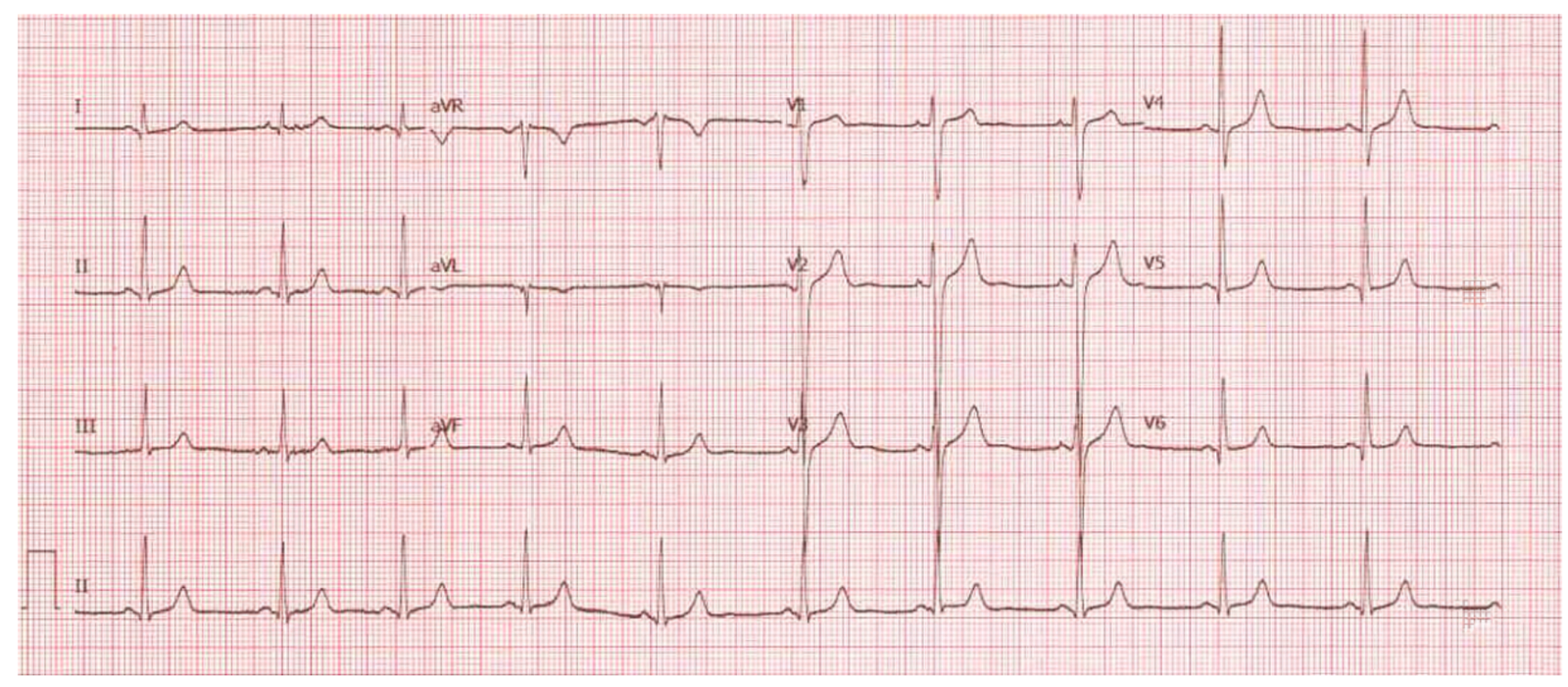
What are your differentials at this time?
The commonest causes of falls in elderly would be valve disease, arrhythmia, and orthostatic hypotension. In this patient all three are possible. Hence further investigations and monitoring are needed to identify the exact cause.
The patient is now on telemetry and you have been bleeped again by the ward team as she has a low heart rate of 44 bpm, but remains asymptomatic. How would you like to proceed?
I would review her telemetry trace:

This shows 2:1 AV block and the patient is at high risk of further symptomatic episodes. I would therefore immediately discuss this patient with the Cardiology team/ CCU and request for a transfer and isoprenaline infusion/ temporary pacing. In the meantime, attaching external pacing pads in coordination with the acute care team would be safer. I would suspend/ stop her Bisoprolol.
I would convey to the patient/ her next of kin (with her consent) the diagnosis and the plan of management: monitoring and possible urgent intervention for high degree block such as infusions/ temporary pacing and would keep them updated about the clinical situation as it evolves. I would also explain that she is likely to need a permanent pacemaker implant and what this involves.