
Interview Course 2 Sections48 LessonsLifetime
Chest pain-1 (ACS)
Question
A 60 year old patient was admitted with atypical chest pain 12 hours ago to the AMU. He has poorly controlled hypertension. The nurse has alerted you that this patient is complaining of new chest pains during your night shift. How would you approach this patient?
Answer
I would start by getting a focused history from the patient regarding the chest pains (SOCRATES) and also specifically ask whether this pain started at rest or on exertion. I would also quickly go through the other systemic symptoms and do a focused systems review and a quick history of his baseline and vascular risk factors.
After this I would start the assessment using the A to E approach.
- Airway – I would ensure the airway is patent and if necessary insert an airway adjunct such as OP or NP airway. If the patient is tolerating an airway adjunct I would be really worried and seek the help of the critical care team after my assessment.
- Breathing – I would look at the observations specifically the oxygen saturation and the respiratory rate. If the patient is hypoxic or if the patient has an increased work of breathing I’ll start the patient on supplemental oxygen therapy. I would also get an ABG for this patient to see what the pH, Po2, pCO2, and HCO3.
- Circulation – I would look at the observations specifically the BP, heart rate, and CRT. If there is evidence of hypotension or tachycardia, I would give a fluid challenge to the patient to see if there is an adequate response. And if the patient remains hypotensive despite the first fluid challenge, I will give another fluid challenge and ensure the critical care team is aware of the patient. I would also ensure the patient has a working cannula and send basic bloods including repeat troponins. I would also request an ECG for the patient.
- Disability – I would check the patient’s blood glucose, temperature, and do a focused neurological assessment that includes GCS. Specifically, if the GCS is less than 8 or if there are focal neurological deficits, I would be concerned and investigate this further.
Question
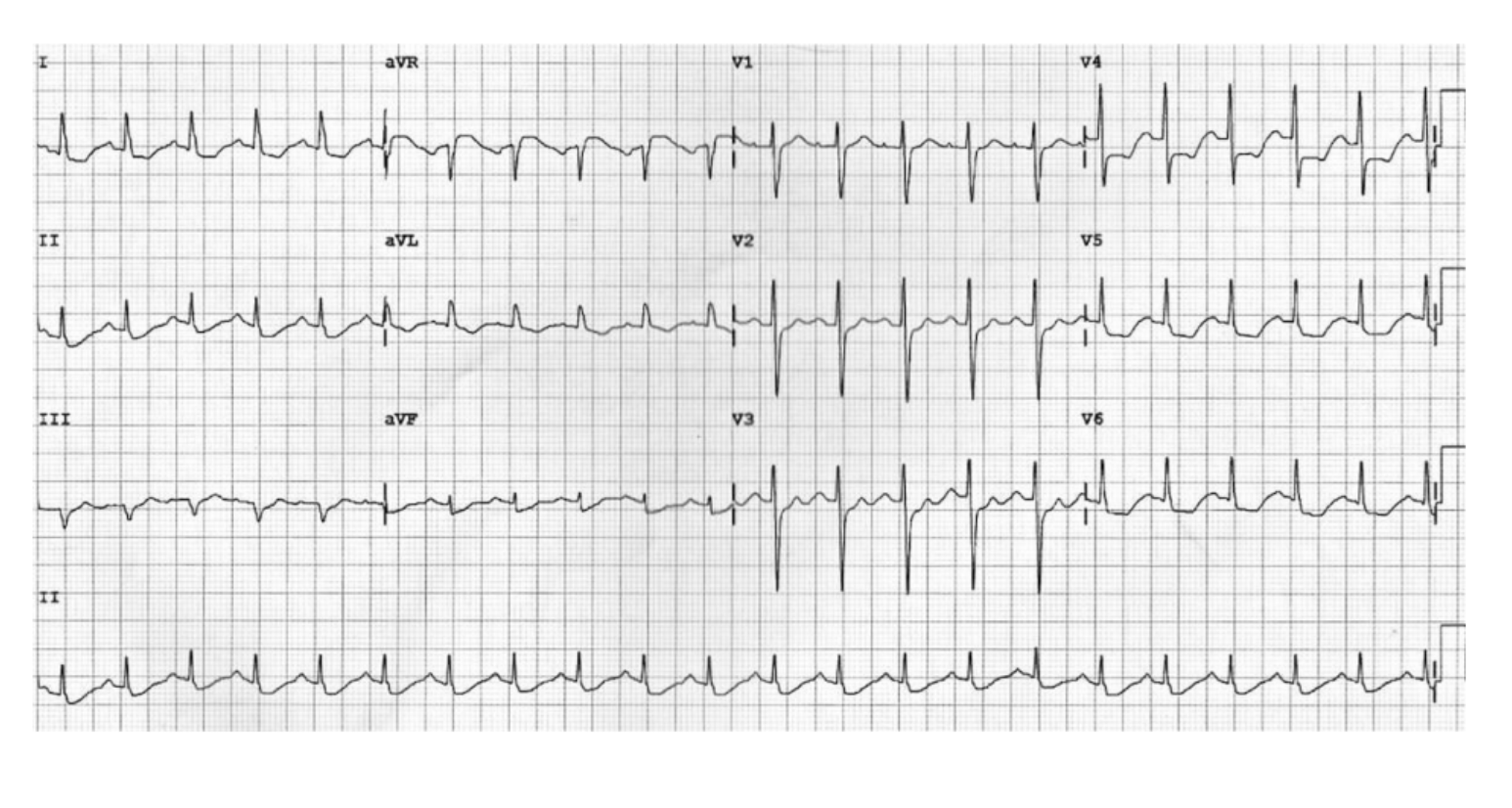
At this point please give the candidate the following ECG and mention that the patient started having chest pains at rest.
Answer
There’s evidence of ST segment depression in the inferolateral leads and I would compare with the old ECGs to see if there’s a change from earlier. I would repeat the ECG again in 20-30 minutes’ time to look for dynamic changes. I would start the patient on DAPT therapy after loading with 2 antiplatelets, I would give GTN puffs (two puffs SL/5 min until pain-free; infusion if ongoing pain after three SL doses, provided not hypotensive) and fondaparinux. I would also initiate the patient on secondary prevention medications and advice (modifiable risk factors modification (smoking, obesity, DM, BP, cholesterol), β-blocker, statin, anti-platelets (aspirin indefinitely, P2Y12 inhibitor usually for at least 1 year), ACEi, and anti-anginals (β-blockers, amlodipine, nitrates, nicorandil, ranolazine, revascularization).
I will let my seniors be aware of the patient and refer the patient to the cardiology team as he has resting cardiac chest pains with ECG changes as he could be a candidate for PCI.